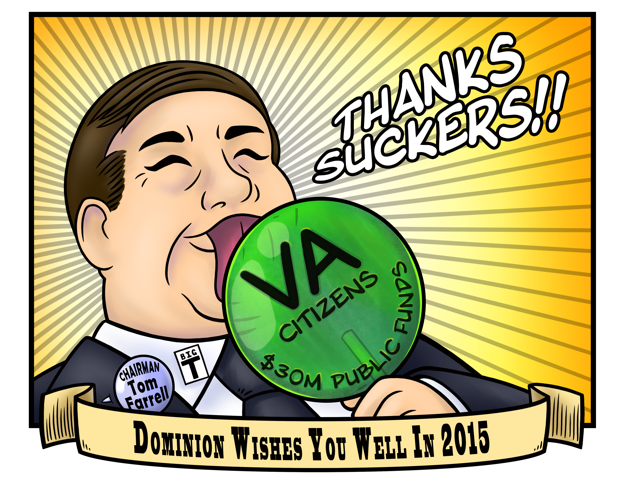
Dominion CEO Tom Farrell Wishes Us All a Happy 2015!
Friday, January 16, 2015
ince he's wallowing around in $30 million of our tax money (ain't taxpayer-funded corporate welfare grand?); skewing Virginia's energy policy in a harmful, pro-fossil-fuel direction that hurts all of us; and earning $10.9 million in compensation in 2013, while hiscompany earned $545 million in the third quarter of 2014 alone, I suppose the least he can do is wish us "suckers" a happy 2015. One thing's for sure: Tom Farrell will be livin' large this year (and for many years to come), given his company's protected monopoly status, not to mention its (wildly corrupt) de factoownership of the Virginia General Assembly, State Corporation Commission, etc. :(

Everything Wrong with Virginia Government Summarized in Three Graphics
Thursday, January 15, 2015
 By now it's clear that if it means anything, the laughable phrase "the Virginia Way" comes down to government of the wealthy/powerful corporations, by the wealthy/powerful corporations, and FOR the wealthy/powerful corporations. That reality is pounded home when you look at who's sponsoring - and who's attending - "2015 Chamber Day at the Capitol" (see the graphics at right, and the two on the "flip").Note that these aren't just ANY corporations, but some of the worst - most polluting, destructive, harmful, etc. - corporations in Virginia: Altria (nee Philip Morris, purveyors of products that cause lung cancer, emphysema, etc.); CONSOL Energy (remember Ken Cuccinelli's Conflict of Interest Problem: The CONSOL Energy Campaign Contributions Timeline and Inspector General Says Ken Cuccinelli's Office 'Inappropriately' Aided Energy Companies and BREAKING: Cuccinelli's Office Improperly Helped CONSOL Energy Rip Off SWVA Landowners?); Appalachian Power, Dominion, Alpha Natural Resources (basically, "global warming and blowing up mountains start here"), etc. By now it's clear that if it means anything, the laughable phrase "the Virginia Way" comes down to government of the wealthy/powerful corporations, by the wealthy/powerful corporations, and FOR the wealthy/powerful corporations. That reality is pounded home when you look at who's sponsoring - and who's attending - "2015 Chamber Day at the Capitol" (see the graphics at right, and the two on the "flip").Note that these aren't just ANY corporations, but some of the worst - most polluting, destructive, harmful, etc. - corporations in Virginia: Altria (nee Philip Morris, purveyors of products that cause lung cancer, emphysema, etc.); CONSOL Energy (remember Ken Cuccinelli's Conflict of Interest Problem: The CONSOL Energy Campaign Contributions Timeline and Inspector General Says Ken Cuccinelli's Office 'Inappropriately' Aided Energy Companies and BREAKING: Cuccinelli's Office Improperly Helped CONSOL Energy Rip Off SWVA Landowners?); Appalachian Power, Dominion, Alpha Natural Resources (basically, "global warming and blowing up mountains start here"), etc.In a way, what's even MORE disturbing here is that there's no citizens' or environmental equivalent to this dirty/destructive corporate festival with Virginia's top political leadership, several of whom - Tommy Norment, Bill Howell, Dick Saslaw - are completely bought and paid for by these corporations. And the reason why there isn't such balance? Simple: these corporations have the money to throw an event like this, not to mention donate millions of dollars to essentially "capture" Virginia government; citizens generally do not have money like that. And no, the pathetically weak "ethics reform" we're likely to see coming out of the General Assembly this year won't lay a globe on stuff like this. In fact, events like "2015 Chamber Day at the Capitol" make a complete mockery of the very concept that these people could ever reform the rancid, corrupt system of which they are an integral part. |
Rep. Bob Goodlatte (R) Says It's Not "Necessary" to Address SCOTUS Gutting of Voting Rights Act
So, is Rep. Bob  |
Dominion learned the meaning of community in Nelson County
by Pontoon
(Dominion: Making friends and influencing enemies? Not in Nelson County. - promoted by lowkell) The day after Dominion sued an additional 39 landowners to include Nelson's Sheriff David Brooks, it hosted one of its dog and pony shows in Nelson County. Hundreds of landowners and citizens schooled Dominion on what it means to live in and be a part of a community.Standing shoulder-to-shoulder, attendees broke out in song, singing the chorus from Robin and Linda Williams anti-pipeline song, "We Don't Want Your Pipeline." Later during the event, in support of an African American community which will be devastated if the ACP is ever built and whose ancestors were given land by their slaveholders after emancipation, citizens and landowners stood arm-in-arm belting out a revised version of the old hymn, "We Shall Overcome." The day after Dominion sued an additional 39 landowners to include Nelson's Sheriff David Brooks, it hosted one of its dog and pony shows in Nelson County. Hundreds of landowners and citizens schooled Dominion on what it means to live in and be a part of a community.Standing shoulder-to-shoulder, attendees broke out in song, singing the chorus from Robin and Linda Williams anti-pipeline song, "We Don't Want Your Pipeline." Later during the event, in support of an African American community which will be devastated if the ACP is ever built and whose ancestors were given land by their slaveholders after emancipation, citizens and landowners stood arm-in-arm belting out a revised version of the old hymn, "We Shall Overcome."Dominion's tax projections given to the media and local governments were questioned. How Dominion would deal with the landslide propensity of Nelson's thin soils on steep slopes; water quality protection; fire protection; and many other concerns were shared. Because of a natural gas pipeline explosion in Mississippi early Wednesday morning, many residents were quick to question Dominion's safety record. The canned responses from Dominion were mostly unsatisfactory to landowners and community members alike. |
Video, Prepared Text: Gov. Terry McAuliffe's State of the Commonwealth Address
Wednesday, January 14, 2015
State of the Commonwealth Address |
A win-win-win solution to protect our coast
by drobinson
 (A shortened version of this piece originally appeared in the January 13th edition of the Richmond Times Dispatch as an op-ed. Dawone Robinson - Virginia Policy Director with the Chesapeake Climate Action Network)Have you ever put together a list of items you would purchase if you won the lottery-before you remembered that you haven't even purchased a ticket? Upon reflection, how premature was that list you so perfectly pieced together? (A shortened version of this piece originally appeared in the January 13th edition of the Richmond Times Dispatch as an op-ed. Dawone Robinson - Virginia Policy Director with the Chesapeake Climate Action Network)Have you ever put together a list of items you would purchase if you won the lottery-before you remembered that you haven't even purchased a ticket? Upon reflection, how premature was that list you so perfectly pieced together?In Virginia, we face a similar dilemma when it comes to addressing the mounting crisis of flooding along our coast. We've got plenty of laudable lists in the works. Last year, Virginia lawmakers unanimously passed a resolution establishing a joint subcommittee to study recurrent flooding issues and adopt recommendations. Legislators from both parties sent a unified message: flooding is a problem in Hampton Roads and we need to do something about it. In 2008, former Governor Tim Kaine's Climate Change Commission laid out more than 100 recommendations to mitigate and adapt to climate change and sea level rise. So far the state has failed to adopt a plan to execute them. To his credit, Governor Terry McAuliffe recently launched a similar commission. This panel, the state's Secure Commonwealth Panel, and the General Assembly's aforementioned recurrent flooding subcommittee all have the same mandate: convene, discuss, deliberate, and draft a set of recommendations. So what's the catch? While what needs to be done is relatively easy to identify, the cost is significant-if not staggering. Virginia needs to win the equivalent of a multi-hundred-million-dollar lottery every year to fund the adaptation measures required to protect coastal residents and infrastructure. Hampton Roads is home to the world's largest naval base, more than $80 billion in economic activity, and 1.7 million residents who routinely feel the effects of sea level rise. Streets need to be raised, levees need to be built, and homes and businesses need to be protected. The U.S. branch of the Dutch engineering firm Fugro estimated that it would cost the city of Norfolk at least $1 billion to fully adapt to rising seas and frequent flooding-which equals Norfolk's entire annual government operating budget. |
New Study: Offshore Wind Would Create More Jobs than Offshore Oil Drilling in VA, Mid-Atlantic
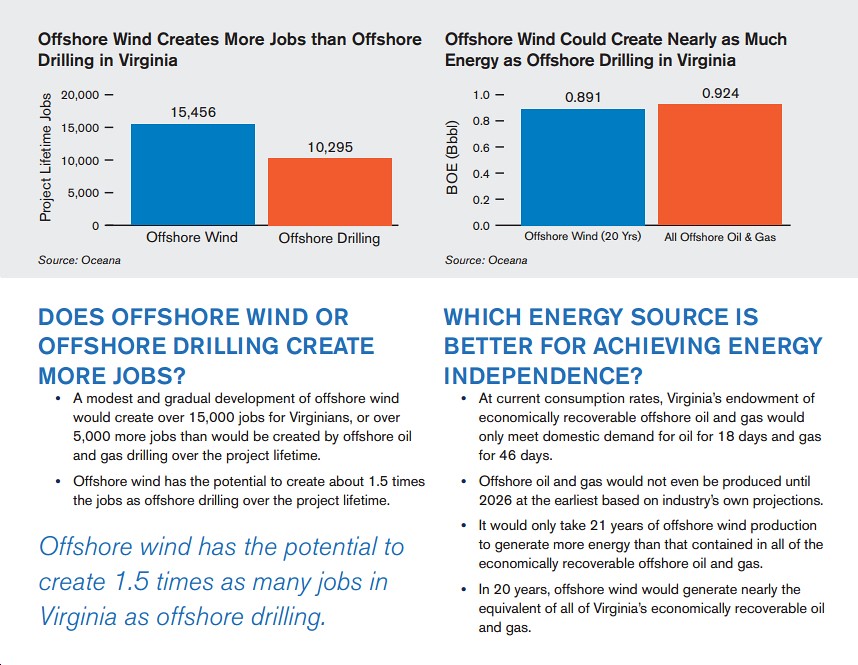 For anyone who thinks that dirty, dangerous, polluting offshore oil drilling is the answer to our energy and economic challenges, or just as wrongly that wind power is NOT the answer, check out this new report by Oceana and find out how misguided that belief is. A few key points from this report include:*"...many of the arguments made about the benefits of offshore drilling do not stand up to scrutiny, and the benefits of offshore wind prove to be greater and available over a longer period of time." For anyone who thinks that dirty, dangerous, polluting offshore oil drilling is the answer to our energy and economic challenges, or just as wrongly that wind power is NOT the answer, check out this new report by Oceana and find out how misguided that belief is. A few key points from this report include:*"...many of the arguments made about the benefits of offshore drilling do not stand up to scrutiny, and the benefits of offshore wind prove to be greater and available over a longer period of time."*"The oil industry's estimates are often based on unrealistic assumptions about the job growth potential of developing oil and gas." *"On the other hand, developing even a modest amount of available offshore wind resources would be a far better strategy to lead the U.S. toward energy independence, while generating hundreds of thousands of new jobs." *"Unlike offshore drilling, offshore wind provides power directly to coastal communities without resulting in pollution, carbon dioxide emissions or spills." *"The Atlantic has minimal fossil fuel resources compared to other regions used or being considered for domestic oil and gas production," so little that "oil consumption could actually only be met for 132 days and gas consumption for only 283 days." Pitiful. *"A modest and gradual development of offshore wind on the East Coast could generate up to 143 gigawatts of power over the next 20 years, which is enough to power over 115 million households." *"In the next 20 years on the U.S. East Coast, offshore wind could create about 91,000 more jobs than offshore drilling, which is about double the job creation potential." *"In just 13 years of producing energy, offshore wind could generate more energy than could be provided by all of the economically recoverable offshore oil and gas resources." *"Along the Atlantic coast, nearly 1.4 million jobs and over $95 billion in Gross Domestic Product (GDP) rely on healthy ocean ecosystems, mainly through fishing, tourism and recreation (and those would be put at serious risk by offshore oil drilling). *Virginia has 11.3 gigawatts (GW) of offshore wind power potential. To put that in perspective, Virginia as of 2012 had 5.2 GW of coal-fired generating capacity and 5.7 GW of natural-gas fired generating capacity -- slightly less, combined, than Virginia's offshore wind power potential. *Offshore wind would create 15,456 jobs in Virginia, 1 1/2 times greater than the 10,295 jobs offshore oil drilling would create, but again without the risk of environmental damage. *Also keep in mind that when the oil runs out, the jobs run out too. In stark contrast, wind power will never run out, which means that the jobs will alsonever run out. All "without the risk of a catastrophic oil spill." Is this a no brainer or what? One more point: offshore wind power is booming in many places around the world, just not here in the United States, thanks to our wildly biased, pro-fossil-fuel energy policies. For instance, in Europe, as of the end of 2013 there were "2,080 turbines...installed and grid connected, making a cumulative total of 6,562 MW, in 69 wind farms in eleven European countries." During the first half of 2014, another 781 MW of offshore wind power came online in Europe, with 1,200 MW more awaiting grid connection. All told, in Europe, the "total capacity of all the wind farms under construction is over 4,900 MW when fully commissioned." The results of this offshore wind power boom in Europe? See U.K. And Germany Smash Wind Power Records for an idea: "wind generated enough electricity to power just over 25 percent of U.K. homes in 2014;" "Scotland hopes to generate the equivalent of 100 percent of its electricity from renewables by 2020." Also see Denmark Sets World Record For Wind Power Production and Germany & Denmark Join Britain In Smashing Wind Energy Records and UK Offshore Wind Installations Forecast to Soar and...getting the picture? In short, Europe is putting the United States to shame when it comes to offshore wind power. Of course, it doesn't have to be this way; the U.S. has enormous wind resources -- as the Oceana report points out, "enough to power over 115 million households" -- so this is mostly a political issue. Finally, note that offshore wind costs are plummeting, with Siemens recently projecting "a 40% drop in the price of offshore wind...within the next 10 years, or 30% at the least." Again, what are we waiting for exactly? Paging Dominion Virginia Power! Paging Dominion Virginia Power! LOL |
New Analysis: Low-Income Taxpayers in Virginia Pay Higher Rate Than the Rich
| From the Commonwealth Institute, this is appalling albeit (sadly) unsurprising in a state that's basically owned and operated by corporate interests and the wealthy. Ugh.
RICHMOND, VA -- The lowest income Virginians pay 74 percent more in taxes as a percent of their income compared to the state's wealthiest residents, according to a new study released today by the Institute on Taxation and Economic Policy (ITEP).
The study, Who Pays?, analyzes tax systems in all 50 states and factors in all major state and local taxes, including personal and corporate income taxes, property taxes, sales and excise taxes, and federal deductions for high-income taxpayers who itemize. "This report contains important information about the challenges facing Virginia and should be required reading for lawmakers as the legislative session gets under way," says Michael Cassidy, President of The Commonwealth Institute for Fiscal Analysis, a Richmond-based fiscal and economic policy organization.
Virginia's tax system is unfair, or regressive, because the lower a person's income, the higher their effective tax rate. This is in part because Virginia relies heavily on sales taxes to raise revenue, has a nearly flat personal income tax, and doesn't have a refundable earned income credit.
The full report, Who Pays?, can be found online here. "With the recent increase in the state sales tax and changes to the gas tax, lower-income people are getting hit even harder," says Cassidy. "But there's a good solution," he adds. "Making Virginia's earned income credit refundable would help working people support their families and make our state's tax system more fair." How Virginia taxes residents matters for myriad reasons. In recent years, anti-tax advocates have pushed for tax policies across the country that would reduce tax rates for the wealthy and businesses. Specifically in Virginia, there have been proposals to eliminate corporate income taxes and local business taxes. There are clear problems with this agenda. Foremost, many anti-tax proposals would make regressive tax structures even worse in part because they often rely on hiking taxes that fall more heavily on poor and middle-income families to pay for tax cuts at the top. Second, aggressive tax cuts that favor businesses and the wealthy can result in states having difficulty adequately funding basic public obligations such as education. There's also a more practical reason for Virginia and all states to be concerned about regressive tax structures, according to ITEP. If the nation fails to address its growing income inequality problem, states will have difficulty raising the revenue they need over time. The more income that goes to the wealthy (and the lower a state's tax rate on the wealthy), the slower a state's revenue grows over time. "In recent years, multiple studies have revealed the growing chasm between the wealthy and everyone else," said Matt Gardner, executive director of ITEP. "Upside down state tax systems didn't cause the growing income divide, but they certainly exacerbate the problem. State policymakers shouldn't wring their hands or ignore the problem. They should thoroughly explore and enact tax reform policies that will make their tax systems fairer." |

Video: Virginia House of Delegates is Baaaaaaack!
| With Joe Morrissey sworn in a little while ago by House of Delegates Clerk Paul Nardo, and with the Pledge of Allegiance having been recited, the Virginia House of Delegates is baaaaaaack in session. I'm sure they'll pass all kinds of fine, progressive, pro-environment legislation this session. Or more likely, it will be a right-wing s*** show. Anyway, as I said, they're baaaaack! LOLP.S. Reporter @MichaelLeePope just tweeted, ".@SpeakerHowell says he forgot to inform Senate that House is ready to proceed; @RobertGMarshall jokes, 'Don't tell them!'" Also, @RTDSchapiro tweeted, "He's got cojones: @DelJoeMorrissey says bouncing him from #Va House after jailhouse win in special elex would 'taint and sully' legislature." |
Another Governor for Virginia to Follow on Energy, Climate Policy
Tuesday, January 13, 2015
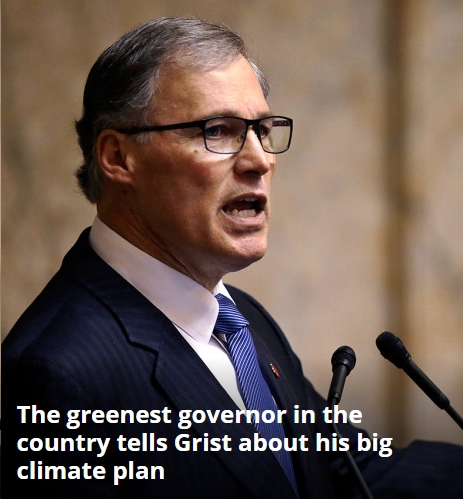 The other day, I highlighted California Gov. Jerry Brown's State of the State address as a model for state-level energy and climate policy. In Gov. Brown's speech, he set ambitious goals: increasing "from one-third to 50 percent our electricity derived from renewable sources;" reducing "petroleum use in cars and trucks by up to 50 percent;" doubling the efficiency of buildings in the state. He further laid out a vision for "more distributed power, expanded rooftop solar, micro-grids, an energy imbalance market, battery storage, the full integration of information technology and electrical distribution and millions of electric and low-carbon vehicles." As I noted, all of these things would be superb to see in Virginia, and I encouraged Gov. McAuliffe to be as bold, as "big ideas" as Gov. Brown, in his State of the Commonwealth speech tomorrow.If Gov. McAuliffe needs more ideas, he should read The greenest governor in the country tells Grist about his big climate plan - an interview between David Roberts of Grist and Washington State Gov. Jay Inslee. Recently, Gov. Inslee "unveiled an ambitious policy agenda anchored by two interlocking pieces": 1) "a carbon cap-and-trade system, the revenue from which will be divided among transportation, education, and assistance for low-income Washingtonians and affected industries"; and 2) "a 10-year, $12 billion transportation plan...funded by a combination of carbon revenue and more traditional sources - the gas tax, license fees, etc." The other day, I highlighted California Gov. Jerry Brown's State of the State address as a model for state-level energy and climate policy. In Gov. Brown's speech, he set ambitious goals: increasing "from one-third to 50 percent our electricity derived from renewable sources;" reducing "petroleum use in cars and trucks by up to 50 percent;" doubling the efficiency of buildings in the state. He further laid out a vision for "more distributed power, expanded rooftop solar, micro-grids, an energy imbalance market, battery storage, the full integration of information technology and electrical distribution and millions of electric and low-carbon vehicles." As I noted, all of these things would be superb to see in Virginia, and I encouraged Gov. McAuliffe to be as bold, as "big ideas" as Gov. Brown, in his State of the Commonwealth speech tomorrow.If Gov. McAuliffe needs more ideas, he should read The greenest governor in the country tells Grist about his big climate plan - an interview between David Roberts of Grist and Washington State Gov. Jay Inslee. Recently, Gov. Inslee "unveiled an ambitious policy agenda anchored by two interlocking pieces": 1) "a carbon cap-and-trade system, the revenue from which will be divided among transportation, education, and assistance for low-income Washingtonians and affected industries"; and 2) "a 10-year, $12 billion transportation plan...funded by a combination of carbon revenue and more traditional sources - the gas tax, license fees, etc."Of course, our Republican/Dominion-controlled, fossil-fuel-bought-and-paid-for General Assembly wouldn't approve such a plan, but that's no reason not to tell the people of Virginia what needs to be done, what should be done, for our economic and environmental future. I'd also point out that Washington State has a Republican-controlled Senate and a narrowly-divided House, so it's not THAT much different in some ways there than it is here. Another great idea comes from Virginia Delegate Ron Villaneuva (R-Virginia Beach), as outlined in this op-ed in this morning's RTD. In sum, here's what Villaneuva's bill, the "Virginia Coastal Protection Act," would do: *"By joining the state into the highly successful and fully established Regional Greenhouse Gas Initiative, or RGGI, the bill would generate more than $200 million per year in new state funds to invest in coastal adaptation and other climate change solutions." *"Under Villanueva's bill, half of Virginia's projected $200 million in annual auction revenues would fund coastal adaptation efforts, 35 percent would fund energy efficiency and renewable energy projects and 10 percent would fund workforce development, education and economic assistance in Southwest Virginia." *"The Virginia Coastal Protection Act is a win-win-win solution. We can establish a consistent and significant source of revenue to tackle flooding in Hampton Roads and generate funds to invest in other statewide priorities, while putting policies in place to help Virginia meet carbon reduction goals in an efficient and practical manner." Given that Virginia will have to meet EPA Clean Power Plan goals regardless, and given that switching to clean energy would constitute a huge boost for Virginia's economy, what Del. Villaneuva (R) is proposing should be a no-brainer for everyone to get on board with. As an added bonus, note that since 2008, "electricity prices have dropped by 8 percent in participating [RGGI] states, compared to a 6 percent rise throughout the rest of the nation." Lower electricity prices and carbon pollution combined with additional revenues for coastal adaptation, workforce development, education and economic assistance in SW Virginia? Why would anyone, other than the fossil fuel companies and the politicians they've bought and aid for, oppose that? Got me. |
Subscribe to:
Posts (Atom)